The History of Pizza

The History of Pizza
Most people would assume that pizza is a traditional Italian food — but is this really true? The origins of pizza stretch back some 6,000 years to Ancient Egypt. To celebrate the pharaoh’s birthday, Egyptians would offer flatbread made simply from flour and water. This type of flat‑bread is even mentioned in the well‑known biblical passage in which Moses leads the enslaved people across the Red Sea. Back then, however, the bread was extremely hard, tough to swallow and difficult to digest; it was barely edible at all. It served only as an offering for religious rituals and festive ceremonies.
Why was that early bread so unpalatable? It was missing one magical ingredient: yeast. The discovery of fermentation also took place in Ancient Egypt 6,000 years ago. Legend has it that a poor Egyptian servant‑girl forgot a batch of mixed dough, which sat at room temperature for several days before she remembered it. Unwilling to throw it away, she flattened the dough into a flatbread and baked it in the oven. To her surprise, the finished bread turned out light, fluffy and delicious. Today we can easily understand that yeast had developed in the dough left at room temperature for days, and fermentation gave the bread its soft, pleasant texture. The discovery of fermentation greatly improved the taste and digestibility of wheat‑based foods, laying an important foundation for the later birth of pizza. Historical records show that from that point onward, similar flatbreads appeared one after another across Mediterranean lands, including North Africa, Southern Europe and the Middle East. Even so, these flatbreads were mostly used by chefs to test oven temperature. After preheating the oven for a while, chefs would slide one of these flatbreads inside. By observing how quickly and thoroughly it baked, they estimated the internal oven temperature. It would be a very long time before flatbread became widely eaten as food.
In the 16th century, tomatoes were brought from Peru to Southern Europe and gradually became a common vegetable on Italian tables. Still, it was another two hundred years before tomatoes were used on pizza. It was not until the 18th century that people in Naples first tried baking flatbread topped with simple ingredients: tomatoes, olive oil and salt. This marked the emergence of the early prototype of modern pizza — plain flatbread enhanced with extra toppings. Even at this stage, pizza remained food for the poor. People topped their pizzas with cheap, strongly‑flavoured ingredients such as salt‑dried fish, garlic, fatty pork and old, hard cheese. In his travel journal, the celebrated 19th‑century French Romantic writer Alexandre Dumas wrote: “This topped flatbread (pizza) I ate in Italy bears a strong resemblance to the flatbread from Saint‑Denis in France.” This further confirms that, as fermentation techniques for dough advanced and imported ingredients grew more abundant across Mediterranean nations, foods resembling modern pizza emerged in multiple places, and the modern pizza began to take shape.
Between the late 18th and early 19th centuries, pizza grew increasingly popular among Italians and spread across different regions. The very first pizzerias opened in Naples. The pizza craze even reached nobles and royalty, who began experimenting with luxury toppings. Sweet dessert‑style pizzas became fashionable among aristocrats, since sugar was an expensive imported good, a symbol of wealth and status.
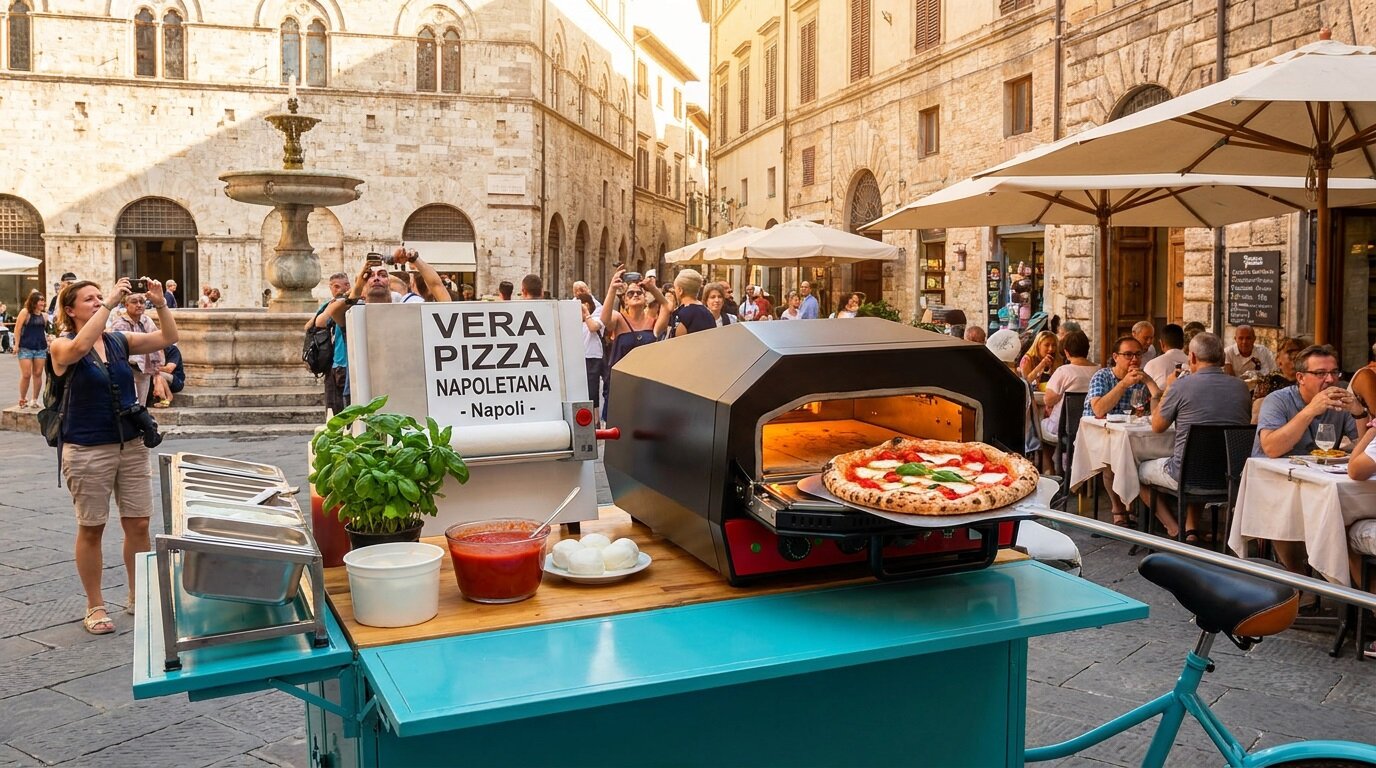
Italy’s most iconic pizza, universally recognised worldwide as the classic traditional Italian pizza, is the Margherita. It was created on June 9, 1889. Queen Margherita di Savoia invited Raffaele Esposito, Naples’ most famous pizzaiolo, to prepare a special dish for her. After careful thought, Raffaele presented three pizzas. The first had a tomato base topped with garlic, olive oil and parsley. The second was a tomato‑based pizza with small white fish. The third featured a tomato base topped with mozzarella di bufala, garnished with fresh basil leaves. Queen Margherita was delighted by the appearance of the third pizza: the red of the tomato sauce, the white of the mozzarella and the green of the basil exactly matched the colours of the Italian national flag. After tasting it herself, she showered the pizza with high praise. Raffaele subsequently added this third pizza to his pizzeria’s menu and named it Margherita after the queen. The world‑famous Margherita pizza was thus born.
At the beginning of the 20th century, an economic crisis in Italy drove large numbers of emigrants to neighbouring France and to the New World in the United States. Marseille, the biggest port in the south of France, drew immigrants from Italy, North Africa, the Middle East and elsewhere. Among them, migrants from Naples and Sicily opened pizzerias in Marseille, bringing pizza to France for the very first time.
During the Second World War, supplies were scarce and France introduced rationing for food. Many traditional French restaurants struggled to survive and were forced to close. Thanks to its simple, fast‑to‑make preparation and manageable costs, pizza survived and persisted through these difficult wartime years. The little neighbourhood pizzerias scattered across the country became rare places where people could momentarily forget their hardships, savour good food and share a drink. In this way, this foreign food took deep root in French culture, where it remains popular to this day.
What happened to pizza across the Atlantic Ocean in the United States? Pizza went through local American adaptation and slowly gained popularity in the 1930s. Americans disliked sharp‑tasting ingredients such as garlic, so the traditional Italian‑style pizza was modified: less garlic was used, and greater quantities of American‑style cheese were added. By the 1940s, American‑style pizza had developed its own distinct identity. The most famous variant is Chicago‑style pizza, with a thick crust and layers upon layers of filling, loaded generously with meat and cheese. It differs substantially from authentic Italian pizza and is distinctly American. Because of its thick crust and heavy toppings, this American pizza could not be baked in traditional high‑temperature wood‑fired ovens. This led to the adoption of lower‑temperature conveyor pizza ovens and baking pans, paving the way for the later industrialisation and fast‑food‑style development of pizza in the United States.